
Biblical Counseling
Rooted in Scripture • Directed Toward Change • Professionally Applied
Provided by Dr. John E. Nyman, Jr., M.A., Th.D., BCPC

The Biblical Foundation for Counseling
Biblical Counseling is not a modern invention. It flows directly from Scripture’s teaching on the nature of the human heart, the renewal of the mind, and the process of growth and change.
The Bible teaches that:
- Human problems are rooted in the heart and mind (Proverbs 4:23)
- Thinking must be renewed for life to change (Romans 12:2)
- Scripture is sufficient to teach, correct, and train (2 Timothy 3:16–17)
- Wise counsel produces stability and growth (Proverbs 11:14)
- Change involves putting off old patterns and putting on new ones (Ephesians 4:22–24)
- Believers are commanded to admonish and instruct one another (Romans 15:14; Colossians 3:16)
Biblical Counseling applies these truths directly to real-life struggles—thought patterns, emotional responses, behaviors, and relationships.
Scripture and the Renewal of the Mind
The Bible consistently teaches that transformation occurs through renewed thinking.
- Romans 12:2 teaches that believers are transformed by the renewal of the mind, not by emotional experience alone.
- Ephesians 4 explains that change involves learning truth, abandoning old patterns, and adopting new ways of thinking and living.
- Philippians 4 addresses anxiety by correcting thought focus and teaching disciplined thinking rooted in truth.
- Biblical Counseling works intentionally at the level Scripture emphasizes most: how we think, believe, and respond.
This is why nouthetic counseling and CBT-informed tools work together so effectively—Scripture provides the truth; structured thinking helps apply it consistently.
Scripture and Responsibility in Counseling
Biblical Counseling treats people as responsible moral agents—not victims of circumstance alone.
- Galatians 6 teaches personal responsibility alongside compassion.
- Proverbs repeatedly connects behavior to wisdom or folly.
- James explains how desires influence choices and actions.
This counseling does not shame—but it does call people to growth, repentance, and obedience, because Scripture does.
Scripture and Emotional Struggles
The Bible addresses emotional suffering honestly and directly:
Anxiety (Matthew 6; Philippians 4)
Depression and despair (Psalms; Lamentations)
Anger (James 1; Proverbs)
Fear and trauma (Isaiah 41; Psalm 34)
Biblical Counseling does not deny emotional pain. It provides truth, structure, and direction so emotions no longer govern life.
Frequently Asked Questions (FAQ)
Is Biblical Counseling real counseling?
Yes. Biblical Counseling is structured, goal-oriented, and professional. It involves assessment, direction, application, accountability, and follow-up. It is not casual advice or informal conversation.
How is Biblical Counseling different from secular therapy?
Secular therapy often focuses on self-defined truth, emotional validation, or symptom relief alone.
Biblical Counseling:
- Is grounded in God’s Word
- Emphasizes moral responsibility
- Calls for repentance and renewal
- Aims at life transformation, not just emotional relief
Select CBT tools are used, but Scripture remains the authority.
What is nouthetic counseling?
Nouthetic counseling is a biblical approach rooted in the Greek word noutheteō, meaning to admonish, instruct, and warn lovingly.
It involves:
- Loving confrontation with truth
- Clear instruction from Scripture
- Calling people to change and obedience
- Ongoing encouragement and accountability
It is direct, compassionate, and purposeful.
Do you only use the Bible, or do you use psychology too?
The Bible is the foundation and authority.
However, structured thinking tools (such as CBT methods) are used as servants, not masters—helping people identify and correct faulty thinking so biblical truth can be applied more effectively.
Can Biblical Counseling help with serious issues like anxiety, OCD, or PTSD?
Yes. Biblical Counseling addresses:
- Fear-based and distorted thinking
- Compulsive and obsessive behaviors
- Trauma-shaped beliefs and reactions
Counseling proceeds carefully, responsibly, and with structure. When necessary, referrals to medical or licensed professionals may be recommended.
Is Biblical Counseling judgmental?
No—but it is honest.
Biblical Counseling combines compassion with correction. It offers grace without excusing sin and truth without cruelty.
Scripture calls believers to speak the truth in love (Ephesians 4:15), and that principle governs the counseling process.
How long does counseling last?
Counseling length varies depending on the issue, commitment level, and progress. Some issues are addressed in a shorter time; others require ongoing care. Counseling is progress-focused, not open-ended by default.
Is this counseling confidential?
Yes, within appropriate pastoral and legal limits. Confidentiality is respected unless there is risk of harm, abuse reporting requirements, or legal obligation.
Is Biblical Counseling right for me?
Biblical Counseling is best suited for individuals who:
- Want truth, not just affirmation
- Are willing to examine their thinking and behavior
- Desire real change, not just emotional relief
- Are open to Scripture-based direction
Those seeking purely secular therapy or crisis care may require a different service.
Begin Biblical Counseling
If you are ready for counseling that is truth-driven, structured, and aimed at real change, Biblical Counseling may be the right step.
Sign up today to begin counseling grounded in Scripture, strengthened by disciplined thinking, and directed toward lasting transformation.
Why Biblical Counseling Works
Biblical Counseling works because it addresses the root causes of human struggle rather than merely managing symptoms. It is effective not because it is religious, but because it aligns with how God designed the human mind, heart, and will to function.
Below are the core reasons Biblical Counseling produces lasting change.
1. It Works at the Level Scripture Identifies as Central: the Mind and Heart
The Bible teaches that life is shaped from the inside out. Thoughts, beliefs, and desires precede emotions and behavior.
Scripture teaches that:
- The heart (inner person) directs the course of life
- Thinking must be renewed for transformation to occur
- Behavior flows from belief, not circumstance alone
Biblical Counseling intentionally targets thinking patterns, beliefs, and motivations, which is why it aligns naturally with structured cognitive approaches while remaining rooted in truth.
This is why renewal of the mind (Romans 12) and the putting off / putting on process (Ephesians 4) are central to counseling that actually changes behavior.
2. It Combines Compassion With Correction
Many modern approaches emphasize empathy without direction. Biblical Counseling does not.
Scripture calls for:
- Truth spoken in love
- Loving confrontation when thinking or behavior is destructive
- Instruction that leads to correction and growth
Biblical Counseling works because it does not leave people where they are. It offers compassion for suffering and instruction for change.
This balance prevents two common failures:
- Enabling destructive patterns
- Harsh confrontation without care
Truth and love together produce growth.
3. It Treats People as Responsible Moral Agents, Not Passive Victims
The Bible consistently affirms human responsibility alongside compassion. While circumstances matter, Scripture teaches that individuals are still responsible for how they think, respond, and act.
Biblical Counseling works because it:
- Restores personal agency
- Encourages responsibility without condemnation
- Teaches people they can learn new responses
- Replaces helplessness with purposeful obedience
This framework builds dignity, accountability, and hope, rather than dependence on the counselor.
4. It Provides Clear Structure for Change, Not Open-Ended Discussion
Lasting change requires more than insight. It requires structure, repetition, and practice.
Biblical Counseling works because it includes:
- Clear goals
- Specific instruction
- Practical assignments
- Accountability and follow-up
- A defined process for growth
This mirrors the biblical model of training and discipleship found throughout Scripture (Proverbs; 2 Timothy).
Change becomes measurable, not theoretical.
5. It Addresses Emotional Struggles Without Letting Emotions Rule
The Bible never denies emotional pain—but it never places emotions in authority.
Biblical Counseling works because it:
- Teaches emotional regulation, not emotional suppression
- Helps people evaluate emotions rather than obey them
- Grounds emotional responses in truth, not impulse
This is why Scripture addresses anxiety, anger, fear, and despair by correcting thinking and redirecting focus (Philippians 4; James 1).
When emotions are guided by truth, stability increases.
6. It Produces Lasting Change Because It Is Anchored in Truth, Not Preference
Modern counseling often adapts to cultural trends and personal definitions of truth. Biblical Counseling does not.
It works because:
- Truth is not negotiated
- Moral clarity is maintained
- Right and wrong are not redefined
- Change is anchored in God’s revealed will
Scripture is described as sufficient for teaching, correction, and training in righteousness (2 Timothy 3). Counseling grounded in that sufficiency does not drift with culture.
7. It Aims at Transformation, Not Just Symptom Relief
Biblical Counseling does not aim merely to reduce discomfort. It aims to shape character, thinking, and direction.
This counseling:
- Seeks obedience before emotion
- Pursues maturity, not just relief
- Builds long-term stability
- Encourages perseverance and growth
Symptom relief often follows—but it is not the ultimate goal. Transformation is.
In Summary: Why It Works
Biblical Counseling works because it is:
- Truth-centered
- Mind-renewing
- Responsibility-oriented
- Structured and directive
- Compassionate but corrective
- Grounded in Scripture
- Aimed at real life change
It does not promise ease—but it does produce growth.
Biblical Counseling Addresses the Whole Person
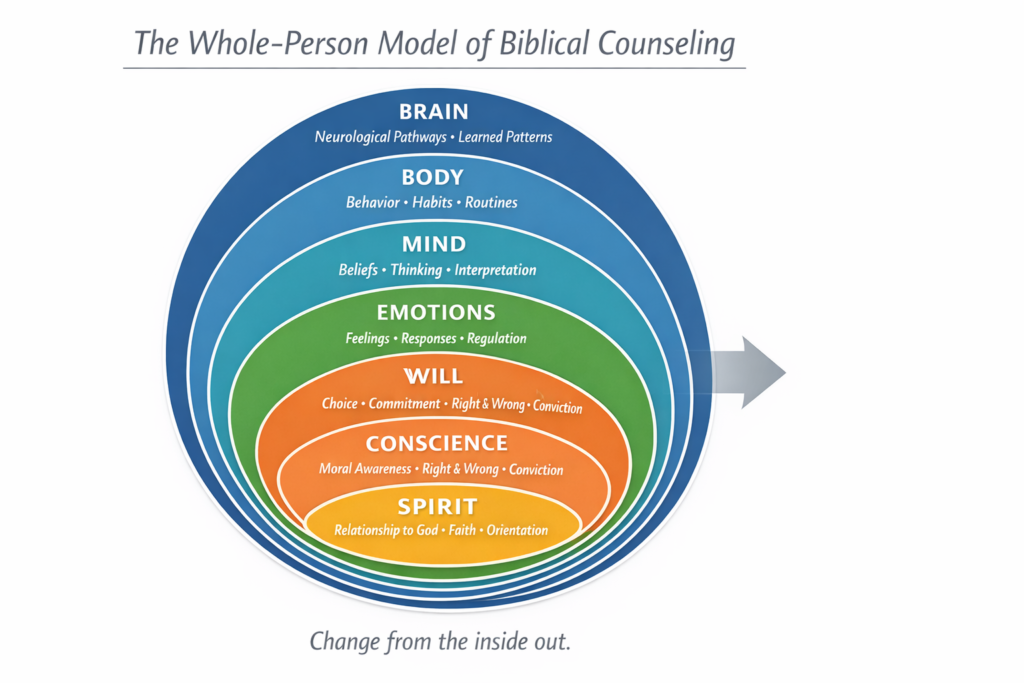
Biblical Counseling works because it treats the individual as a whole person, not a collection of disconnected symptoms. Scripture presents human beings as integrated—body, mind, inner life, and spiritual orientation working together. Problems in one area inevitably affect the others.
Biblical Counseling intentionally addresses the total person, recognizing how each aspect influences thinking, emotion, behavior, and spiritual direction.
The Brain (Neurological Function)
The brain is the physical organ through which thinking, emotion, memory, and behavior are expressed. Stress, fear, trauma, and habitual thought patterns all affect neurological functioning.
Biblical Counseling acknowledges:
- The brain’s role in habit formation and emotional response
- The impact of repeated thinking patterns on stress and anxiety
- The need for disciplined, repeated thinking to form new patterns
This aligns with Scripture’s emphasis on training, discipline, and renewal (Proverbs; Romans 12).
CBT-informed strategies help retrain thinking pathways while Scripture defines the truth guiding that process.
The Body (Physical and Behavioral Life)
The Bible treats the body as significant—not incidental. Sleep, routine, activity, discipline, and physical habits all influence emotional and spiritual health.
Biblical Counseling considers:
- The role of fatigue, stress, and routine in emotional regulation
- Behavioral patterns that reinforce anxiety, depression, or anger
- The importance of self-control, moderation, and consistency
Scripture repeatedly connects bodily discipline with godliness and stability (1 Corinthians 9).
Change often begins with obedient action, even before feelings follow.
The Mind (Thinking and Belief)
The mind is central in Biblical Counseling. Scripture consistently teaches that life direction flows from thinking.
Biblical Counseling addresses:
- Beliefs, assumptions, and interpretations
- Distorted or unbiblical thinking patterns
- Fear-based, hopeless, or entitled thought processes
- Replacement of lies with truth
Transformation is explicitly tied to renewed thinking (Romans 12; Ephesians 4).
This is where nouthetic counseling and CBT tools intersect naturally—truth renews the mind; structure trains it.
The Will (Choice, Responsibility, and Direction)
Biblical Counseling treats individuals as responsible moral agents with the capacity to choose obedience, restraint, and faithfulness.
Counseling addresses:
- Decision-making patterns
- Avoidance versus obedience
- Willful habits versus disciplined choices
- Commitment to change over comfort
Scripture repeatedly emphasizes choosing obedience even when emotions resist (Deuteronomy 30; Joshua 24).
Growth requires willing participation, not passive insight.
The Emotions (Feelings and Responses)
Biblical Counseling does not deny emotions—but it does not allow emotions to govern truth.
Counseling helps individuals:
- Understand emotional triggers
- Distinguish feeling from fact
- Regulate emotional responses
- Respond rather than react
Scripture addresses emotions by redirecting thinking and focus, especially in anxiety, anger, and despair (Philippians 4; Psalms).
Emotions are indicators—not authorities.
The Conscience (Moral Awareness)
The conscience is the internal sense of right and wrong shaped by truth, belief, and practice.
Biblical Counseling addresses:
- Guilt versus false condemnation
- Conviction versus shame
- Moral clarity and accountability
- Training the conscience through truth
Scripture teaches that the conscience must be instructed and aligned with truth (Romans 14; 1 Timothy 1).
A healthy conscience promotes peace and integrity.
The Spirit (Relationship to God)
At the deepest level, Biblical Counseling addresses the individual’s relationship with God. Human struggle cannot be fully understood apart from spiritual orientation.
Counseling considers:
- Trust versus unbelief
- Obedience versus resistance
- Hope rooted in God’s promises
- Growth in faith and perseverance
Scripture teaches that spiritual alignment affects the entire person (Galatians 5).
Spiritual maturity strengthens emotional and behavioral stability.
Why the Whole-Person Approach Matters
Many counseling models isolate one aspect of the person—emotion, cognition, or behavior. Biblical Counseling works because it recognizes that change must be comprehensive.
When the:
- Mind is renewed
- Will is engaged
- Emotions are regulated
- Body is disciplined
- Conscience is informed
- Spirit is aligned with truth
…lasting change becomes possible.
Areas of Counseling & Treatment Focus
Addiction and Compulsive Behavior Counseling
Addictive and compulsive behaviors are often reinforced by distorted thinking, emotional avoidance, and habit loops. Counseling focuses on interrupting these cycles and replacing them with disciplined alternatives.
Counseling for addictions may include:
- Identification of triggers and cognitive distortions
- Behavioral monitoring and accountability
- Replacement of destructive habits
- Development of coping strategies
- Strengthening responsibility and long-term planning
CBT helps individuals understand urges without surrendering to them.
Benefits include:
- Increased impulse control
- Reduced relapse behaviors
- Greater accountability
- Development of sustainable lifestyle changes
Anger Management & Emotional Regulation
Anger is often a secondary emotion driven by distorted perceptions, unmet expectations, or perceived injustice. Counseling focuses on understanding triggers and learning controlled responses.
Anger-focused counseling includes:
- Identifying cognitive triggers for anger
- Challenging entitlement and rigid thinking
- Learning emotional regulation techniques
- Developing constructive communication skills
- Replacing reactive behavior with intentional response
Benefits include:
- Reduced emotional outbursts
- Improved relational stability
- Increased self-control
- Greater personal responsibility
Life Transitions & Adjustment Counseling
Major life changes can destabilize thinking and behavior. Counseling helps individuals regain structure, perspective, and direction.
Counseling may address:
- Decision-making clarity
- Adjustment to change or loss
- Stress management
- Re-establishing routines and goals
Benefits include:
- Increased clarity and confidence
- Reduced stress and confusion
- Improved adaptability
Presenting Concerns Commonly Addressed
This integrative counseling approach is commonly used to address:
- Anxiety disorders and chronic worry
- Depressive thought patterns and behavioral withdrawal
- Marital conflict and communication problems
- Parenting challenges and authority issues
- Addictive and compulsive behaviors
- Anger management and emotional dysregulation
- Life transitions and adjustment difficulties
In Summary
Biblical Counseling addresses:
- The brain through disciplined thinking
- The body through obedient action
- The mind through truth renewal
- The will through responsible choice
- The emotions through regulation
- The conscience through moral clarity
- The spirit through relationship with God
This is not partial counseling.
It is whole-person care, grounded in Scripture and directed toward real transformation.
The Whole-Person Model of Biblical Counseling
Biblical Counseling addresses the total person as Scripture presents them—an integrated being in which spiritual orientation, moral awareness, choices, thinking, emotions, behavior, and neurological patterns interact.
Lasting change occurs when truth transforms the inner person and is practiced outwardly through disciplined thinking and obedient action.